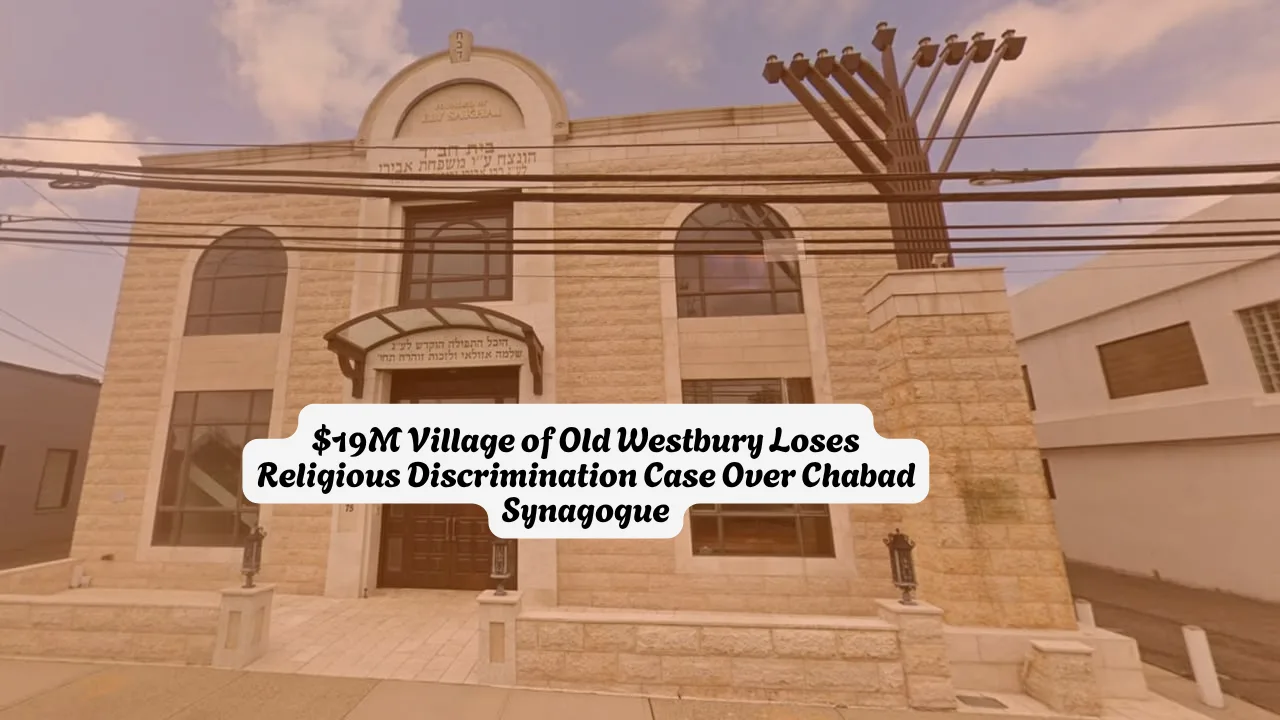
A Decades-Long Battle for Religious Freedom: The Old Westbury Chabad Synagogue Lawsuit Concludes
In a landmark decision underscoring the vital protections afforded to religious freedom in the United States, the Village of Old Westbury, New York, has agreed to pay a substantial $19 million settlement to the local Chabad center. This significant payout brings to a close a nearly two-decade-long legal saga stemming from claims that village officials unconstitutionally blocked the construction of a synagogue. The Old Westbury Chabad Synagogue Lawsuit represents a crucial victory for religious organizations seeking to establish or expand their presence, while also serving as a stark reminder to municipalities about the stringent constitutional boundaries governing land use and zoning.
The protracted dispute began when Rabbi Aaron Konikov and Lubavitch of Old Westbury initiated legal action against the village in 2008. Their lawsuit challenged a specific zoning ordinance enacted in 2001, which they argued was designed to prevent the construction of their synagogue. The settlement, formalized through a consent decree signed by US District Judge Gary Brown in March, marks a pivotal moment for the Chabad community and sets a precedent for how religious land use disputes are resolved.
The Roots of the Dispute: Zoning Ordinances and Alleged Religious Discrimination
The genesis of the Old Westbury Chabad Synagogue Lawsuit traces back to 1999, when Rabbi Aaron Konikov first laid plans for a new synagogue on his 9-acre property along Glen Cove Road, where he already operated a Chabad center. However, the village’s response to these plans was unexpected and, as it turned out, legally problematic. In 2001, just two years after Konikov announced his intentions, Old Westbury passed a new zoning law specifically dictating that houses of worship could only be built on parcels of 12 acres or more.
This ordinance effectively halted Konikov’s construction plans, as his property fell short of the newly imposed 12-acre minimum. While village officials also cited concerns such as potential traffic, parking congestion, noise, and permit issues, the timing and nature of the 2001 law raised serious questions about its true intent. For many religious organizations, particularly those seeking to establish new community centers in suburban environments, acquiring properties of 12 acres or more can be an insurmountable financial and logistical barrier.
Such stringent zoning requirements can disproportionately affect religious groups that may not require vast expanses of land for their operations, or those with limited financial resources. This disparity often becomes the focal point of legal challenges under federal statutes like the Religious Land Use and Institutionalized Persons Act (RLUIPA), which protects religious institutions from discriminatory or unduly burdensome land use regulations.
The Legal Ramifications: Unconstitutional Discrimination and Landmark Rulings
The core of the Old Westbury Chabad Synagogue Lawsuit centered on the claim that the 2001 ordinance constituted unconstitutional discrimination against the free exercise of religion. After years of litigation, US District Judge Gary Brown concurred with this assessment, ruling in October that the ordinance was "unconstitutionally discriminates against the free exercise of religion and is therefore facially invalid." This declaration was a crucial turning point, affirming that the village’s zoning regulation directly violated fundamental constitutional rights.
Judge Brown’s ruling highlighted a critical principle in American law: while municipalities have the authority to implement zoning laws for the public good, these laws cannot be used as a veiled means to hinder or prevent religious practice. When zoning ordinances disproportionately burden religious institutions without a compelling governmental interest, or when they are applied in a discriminatory manner, they are vulnerable to legal challenge. The $19 million settlement agreed upon by Old Westbury and the Chabad center, paid by the village’s insurance providers, underscores the significant financial liabilities local governments can face when their zoning policies infringe upon religious freedom.
Broader Implications for Religious Organizations and Local Governments
The resolution of the Old Westbury Chabad Synagogue Lawsuit carries profound implications for both religious communities and municipal entities across the nation:
- For Religious Organizations: This case is a powerful testament to the persistence required in the face of discriminatory practices. Rabbi Konikov's attorney, Eric Robinson, encapsulated this sentiment, stating, “Rabbi Konikov struggled for 34 years to reach this point. He is grateful for the Constitution and the involvement of the Court.” It empowers other religious groups to stand up against unfair zoning practices, knowing that legal recourse and significant victories are possible. Organizations should be proactive in understanding local zoning laws and prepared to seek legal counsel early if they perceive discriminatory hurdles.
- For Local Governments: The $19 million settlement serves as a cautionary tale. Municipalities must meticulously review their zoning ordinances to ensure they are RLUIPA-compliant and do not inadvertently (or intentionally) create barriers for religious institutions.
- Tip 1: Conduct Regular RLUIPA Audits: Periodically review all zoning ordinances that pertain to houses of worship to ensure they are neutral, generally applicable, and do not impose substantial burdens on religious exercise without a compelling governmental interest.
- Tip 2: Engage in Good-Faith Negotiation: When a religious organization proposes a new facility, engage in open and constructive dialogue. Explore reasonable accommodations rather than relying on overly restrictive blanket rules.
- Tip 3: Understand Legal Exposure: Be aware that violating RLUIPA or the First Amendment can lead to significant financial penalties, as demonstrated by the Old Westbury case and others, such as the Village of Atlantic Beach paying $950,000 to Chabad of the Beaches in a similar dispute.
Building for the Future: A New Era for the Old Westbury Chabad Center
With the legal battle finally concluded, the focus for Rabbi Konikov and Lubavitch of Old Westbury now shifts squarely to construction. Rabbi Konikov expressed his optimism: “Rabbi Konikov and everyone working with him look forward to working cooperatively with the Village, and to building and developing facilities where the community can worship, learn, and grow for decades.” Preliminary plans for the new synagogue indicate a substantial 20,875-square-foot building, complete with an adjacent parking lot, designed to serve the growing needs of the community.
Under the terms of the consent decree, Lubavitch of Old Westbury has until January 15, 2027, to apply for a special-use permit from the village to proceed with construction. This timeline allows for careful planning and collaboration, ideally fostering a more cooperative relationship between the Chabad center and the village moving forward. This resolution not only provides a physical space for worship and community engagement but also symbolizes a triumph of perseverance and the enduring strength of constitutional protections.
Conclusion
The $19 million settlement in the Old Westbury Chabad Synagogue Lawsuit stands as a powerful testament to the enduring principles of religious freedom enshrined in the U.S. Constitution. It underscores that zoning laws, while vital for community planning, cannot be weaponized to obstruct religious practice. For nearly two decades, Rabbi Aaron Konikov and the Lubavitch of Old Westbury fought for their right to build a place of worship, and their tenacity has ultimately yielded a significant victory. This case sends a clear message to municipalities: respect for religious land use is not merely a courtesy, but a constitutional imperative, and the failure to uphold it can carry substantial legal and financial consequences. As the Chabad center now moves forward with its long-awaited construction, it serves as a beacon of hope for religious communities striving to fulfill their mission within the bounds of law and justice.